
“Hello, this is Kate. How may I help you?”
That’s the first thing you’ll hear when you call Garden Vision. What comes back is usually a garden woe, and after more than 30 years, I’ve heard most of them.
“We just moved into a brand-new house. There’s lawn, a few token shrubs, and one tree out front.”
“Our youngest is off to college. We gave the swing set to the neighbors’ kids, and now I want a sunny spot to relax and watch the birds instead of mowing all the time.”
“I bought new plants last month, and they look terrible, even though I water them every day.”
“Everything in our new yard is growing into everything else, and I don’t know what any of it is.”
Sound familiar? Many people want to know a little about the person they’re inviting to their home. So here’s what my landscape design process looks like, from that first hello to the day your plan is in your hands.
It starts with a conversation
About 30 seconds into a call, my head starts nodding. I can usually guess what’s going on. I keep asking questions anyway, because the details matter. How you describe the problem tells me a lot: how frustrated you are, how much gardening you’ve done, what you’ve tried, and where you’ve already looked for help. Sometimes a side comment turns out to be part of the problem, too.
Often I’ll ask whether you’ve noticed something else that tends to show up with the first problem. (It’s a little test of how closely you’ve been looking.) Then I reflect back what I heard, in your own words, and ask, “Did I get that right?”
Your woe may sound like one a client brought me before, so I’ll tell you what we found and how we fixed it. But there may be more going on than either of us can see over the phone. Rather than guess, I’ll ask if you’d like me to come out and walk your yard with you. Then I’ll explain how a Garden Tour Conversation works, including the fee, and we’ll find a date.
Once the date is set, you’ll get my pre-visit worksheets by email, so you can gather your thoughts before I arrive.
At the end of our first conversation, I want you to feel heard. I also want you to have one specific answer to one thing you asked about. Sometimes that answer is the name of a colleague who’s a better fit for what you need. That still counts.
Homework before I visit
Before I come to your garden, I do my homework. It’s one of my favorite parts, because county property records hint at interesting stories.
First comes the photo and sketch page: the view from the street and the floor plan. Then I page through satellite images from past years to see what’s changed. The first time a property showed up as nothing but a dirt pile, I wondered if I’d typed in the wrong address. Another time I spotted what looked like large artworks on the ground, and one of them moved around the yard from year to year. They turned out to be beautiful pieces of iron artwork.
The legal description gets a read, too. I look for the weird ones: go this way so many feet, then that way, over and over. The sales history can tell a story all by itself, especially on older properties that were split up as families changed. And the handwritten plat maps, full of curlicues on poorly scanned copies of copies? Reading them is an adventure, and a history lesson.
On the drive over, I wonder. Will the ground match what I saw from above? What will I see up close that the satellite missed? What does the person I talked to on the phone look like? And will I arrive on time?
The Garden Tour Conversation
We start with the big picture and your Garden Purpose Statement from the worksheets. My favorite question: “What was it about this property, the land, the house, the neighborhood, that made you choose this place to live?” That question opens the door to everything else.
Then we walk and talk. You show me what matters most, and I take notes as we go and keep asking questions, because this time is about you and your garden. The visit runs two hours. At about the 90-minute mark, I check in to make sure your questions are getting answered. Before I leave, you get your personalized Fix-It List: my notes from our walk, on a two-part carbonless form, so a copy of everything we covered stays with you.
Some of my favorite visits: a client I’d first met years earlier, when her kids were teenagers, who showed me the small Eiffel Tower she’d built from scrap metal and rebar. A son from next door who came over to learn how the design process works. His care for his mom showed in every question, and later he gave me CEO-to-CEO advice I still use. A research scientist who turned out to love plants and nature as much as I do. A sports news writer who described me as “the garden elf inspecting everything she sees.” That’s exactly the name I have for the inner me. A recently retired nurse who listened to me describe how a plan comes together and said, “You paint with plants.”
Every one of those visits had the same feeling. We understood each other at a deeper level than strangers do, and we cared about each other, person to person.
Often I don’t need to ask whether you’d like to keep going. You ask me first: “How soon can we start? I’d like to work with you on a design.”
One conversation becomes an agreement
The design notes from our conversation are the seeds of your design, and they carry right into the next step. Right there in the garden, you’ll hear how a typical design project goes. First comes the proposal. It connects my notes to your project’s requirements, maps out the milestones, and proposes a timeline.
I’ll also tell you how many projects I’m working on, where yours fits in the queue, a likely start date, and when you’ll have a proposal to review. Your proposal gets a night’s rest before it goes to you. The next morning I read it with fresh eyes, as a gut check.
Once you sign the agreement, I schedule the site survey. Then we meet for the preliminary plan review, and after that I deliver your final plan, with a payment at each milestone. In between, I stay in touch to get your input.
Site survey day
When I arrive, I knock on the door, say hello, and explain what I’ll be measuring. If you’d like to help, you’re welcome to hold the end of the tape measure. If not, that’s perfectly fine. Either way, we usually end up kibitzing. Before I leave, I’ll find you to say I’m done, and if I found anything surprising, you’ll hear it from me.
Designing together
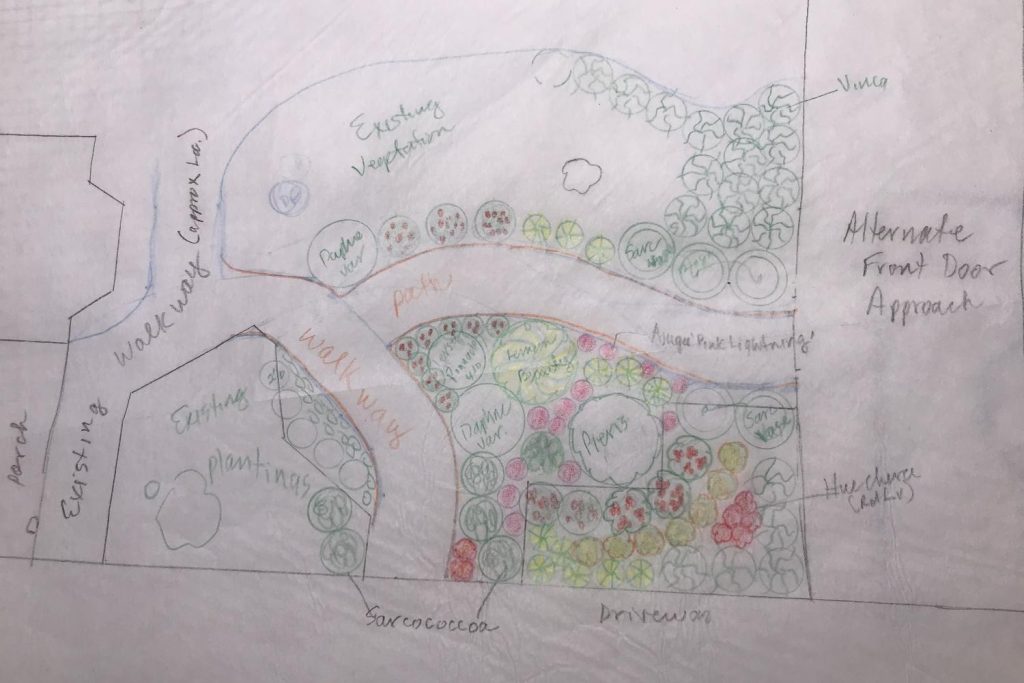
Every plan I draw starts by hand, on gridded paper at 1/8-inch scale. That drawing is the baseline. On top of it go sheets of tracing paper, where the ideas live. Colored pencils fill in the plants, which is the part my nurse client called painting with plants.
Designers have a fancy word for the next meeting: a charrette. I call it designing together. I unroll the baseline, lay the tracing paper on top, and walk you through the options and the decisions to make. Then I pick up the red pencil.
That’s when I see the look of surprise. “Oh! Are we really marking this up?”
Oh yeah, baby. This is your design.
Each choice you make goes onto the drawing in red, right there, so you can watch the plan change. We talk about the plants you love and the ones you don’t. When you’re happy with the direction, I start on the final.
The final plan, scene by scene
The final plan is drawn on a clean sheet of vellum over the baseline, with your red-pencil decisions underneath. Then comes the eyeball test: proportions, lines, repeated plants, color and texture, sun and shade. It usually takes about two weeks, worked in small bites.
When I deliver it, I don’t hand you a drawing and a plant list and leave. (You do get two copies of each.) I describe your garden in scenes.
“From this window, instead of the neighbor’s window, you’ll see these shrubs here, here, and here. They form a soft arc that turns the view into a backdrop of green, with flowering shrubs in summer. And on a cloudy winter day, the bark of this tree will come alive.”
One client couldn’t picture how a group of shrubs off the deck would look. So I borrowed their umbrellas, added mine, and opened them along the deck’s edge. Now they could see how the shrubs would outline it, so a step off the deck wouldn’t turn into a broken ankle.
After the plan is in your hands
The last thing we talk about is building it. I can share resources for the next step, refer you to contractors I trust, help with plant buying, or support the build alongside your contractor.
After that, I’m a phone call or an email away. A fair number of clients call later for advice, sometimes about the design but mostly about plants: “I found this one I like. Will it work?” Some send photos, or invite me over to see what they’ve built.
And almost everyone, somewhere along the way, says something that makes my day. An appreciative word. An unexpected turn of phrase that warms my heart. “I never would have figured this out alone.” Those are the little things I tuck away to remember.
Which part of the process surprised you most? Tell me about it here.
Wondering where your own garden would start? A Garden Tour Conversation brings me to your garden for two hours. We walk it together, and by the time we’re done, you have a personalized Fix-It List that’s yours to keep, plus one clear next step.
No commitment — just clarity.